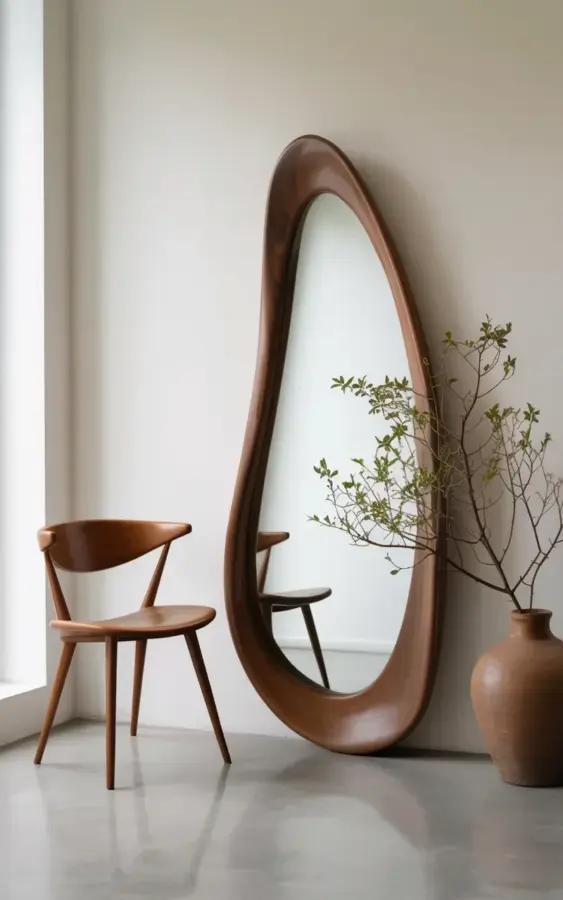
The day I hung the walnut mirror, my white wall finally gave up its blandness. I had rearranged this minimalist interior so many times that the nail holes were starting to outnumber the decor, but this piece ended the cycle. Honestly, the room felt done. Not styled, not decorated. Done.
I want to walk you through what actually worked in this corner, because a lot of Pinterest-worthy setups fall apart the second you live in them. This one didn’t. I think the reason comes down to the combination of shapes, not the number of objects.
## The sculptural mirror is doing all the heavy lifting
Here’s the thing about a sculptural mirror that you don’t realize until you own one: it’s not really a mirror. It’s a piece of art that happens to reflect your face when you check for spinach in your teeth. The organic, flowing wooden frame in walnut brown breaks up the straight lines of the wall and floors in a way a round mirror could never manage.
Mine has this asymmetrical curve, smooth and continuous, like it was poured rather than carved. It leans slightly off-center. You can’t pose it. No matter how you angle it, it just lands in its own way. That’s the appeal. It makes a plain white wall feel intentional without needing a gallery arrangement or a shelf full of knickknacks.
The practical part: walnut is heavy. Not a huge deal, but hang it properly, into a stud. I learned that after my first attempt ended with a thud and a tiny crack in the drywall that I still haven’t patched. The crack is behind the frame, so technically it doesn’t exist. Except I know it’s there.
## Why walnut furniture beats the lighter woods
I’ve tried the blonde woods. The pale oak, the ash, the beech. They look airy and Scandinavian for about a week, and then they start to feel washed out. Walnut does the opposite. It darkens a room in a good way. It adds depth without being heavy, like a warm blanket you didn’t know the space needed.
Walnut furniture against a white wall is one of those combinations that seems basic until you see it in person. The grain carries the eye. The browns bring in the sun. It makes the minimalist interior look almost cozy, which sounds wrong, but it’s true.
For anyone considering walnut for the first time, know this: it’s not uniform. The grain varies from piece to piece. One plank might have a wild swirling pattern, another looks almost straight. That’s not a defect. That’s the whole point of buying wood furniture instead of veneer. Don’t buy a matching set, either. Let the grain patterns run naturally and the room will feel less staged.
## The mid-century chair is the quiet workhorse
The mid-century modern chair came from a thrift flip, not a showroom. Someone had painted it a sad mossy green and left it on the curb. I stripped it down, sanded the arms, and the walnut underneath came out so warm that I almost skipped the finish. A light oil was all it needed.
That chair has four angled legs and a curved backrest that looks like a lowercase n. It’s comfortable for maybe twenty minutes, then you start to feel the history in your lumbar region. I still keep it in the corner anyway. It’s not for sitting for long stretches. It’s for holding the shape of the room.
Here’s the list I wish someone had given me before I started hunting for vintage chairs:
– The backrest curve should hit your mid-back, not your shoulder blades
– Look for joints that fit tight, with no glue crusts hiding underneath
– Test the seat height against a table before you commit to a purchase
– Original wood beats a perfect re-finish every time, those dings are character
– If it makes you smile when you walk past it, that’s the one
## Terracotta and dried branches finish the composition
The terracotta vase sits on the right side of the frame, and it’s doing a quiet job. It adds that orange-brown warmth that bridges the walnut and the white wall. Dried branches with tiny green leaves poke out of it, not arranged gracefully, more like they just grew there in a hurry.
I’ll be honest, the dried branches shed. Every few days a couple of leaves end up on the floor. I could sweep them away, but then the corner feels too clean, too unlived in. So I leave them until vacuum day. It’s a small rebellion against the idea that minimalism has to be sterile.
The terracotta color is one of those tones that works with almost anything. Put it next to olive, next to sand, next to gray wool, it always looks like it belongs. If you’re stuck choosing one accent color for a minimalist interior, terracotta is the safest interesting choice you can make. It’s not boring. It’s not loud. It just holds its ground.
## What actually surprised me about living with this setup
Ok so the thing nobody mentions about a sculptural mirror with organic curves is that it changes throughout the day. Morning light hits the walnut grain one way, afternoon light another way, and at golden hour the whole frame glows like it’s been dipped in honey. I didn’t budget for that. I expected a mirror, and I got a sunrise show instead.
Also, the mirror makes the small room feel larger. Not because it’s a mirror in the classic sense, but because the eye follows the curves and gets drawn into the reflection. It creates this fake depth that plays tricks on your perception. The chair and the vase anchor the edges, so your gaze moves around the space instead of bouncing off a flat surface.
I also learned that a minimalist room isn’t about having less. It’s about making each piece carry weight. When I had the chair, the mirror, and the vase, adding anything else felt like clutter. Removing any one of them felt like a void. Three objects, and the corner was complete. There’s a balance in there, and it took me longer to find it than I’d like to admit.
## How to recreate this corner without the budget
If you want this look, start with the mirror or the chair, not both at once. Hit up flea markets and thrift shops with furniture that’s been sitting for months. People walk past curved walnut frames because they don’t know what they’re looking at. I got my mirror for thirty euros from a woman who was just glad to have it out of her garage.
Paint can resurrect almost anything too. If you find a mid-century silhouette chair with a wrecked finish, sand it down and oil it. You don’t need an expensive restoration. A little elbow grease and patience gets you ninety percent of the way there. And the terracotta vase? Mine was a nine dollar decor piece that looks identical to ones three times the price.
The floor plan matters. Keep the mirror off-center and give the chair enough room to breathe. Let the dried branches get a bit scraggly. Perfect minimalism reads as staged. This corner, with its scattered leaves and its slightly bruised drywall, reads as real. That’s the vibe worth stealing.
Look, I’ve probably stared at this corner more times than a fully balanced person would, and it still holds up. If you’re considering a sculptural walnut mirror or a mid-century chair for your own space, the answer is yes. Start with one piece, live with it for a week, and see what the room tells you. And if it works, save this post for later, and come back to tell me what you found.
Leave a Comment